Automated Request Manager
As a feature of Smart fulfillment, use the Automated Request Manager (ARM) screen to configure automated ILL workflows. Automations are composed of match criteria you define along with actions you want the system to perform on matched requests.
To access this screen, sign in to OCLC Service Configuration, open the WorldShare ILL module from the left navigation, and then select Automated Request Manager.
The Automated Request Manager is divided into two tabs:
- Borrowing (Default)
- Lending
Automations are a combination of:
- Matches: What the request should look like.
- Actions: What the system should do with the request.
- Exceptions (Borrowing only): When you do not want these actions to occur.
- Priority: If a request matches multiple automations, which set of actions should be performed.
Note: Previously configured Direct Request Profiles will appear in the Automated Request Manager as Automations.
Bibliographic matching
Bibliographic matching helps patrons get the item they asked for. When someone submits a new borrowing request through a supported path (listed below), Resource Sharing for Groups searches WorldCat using the citation on the request. It finds WorldCat records that count as good matches for that request.
The system then picks one main, best matched, WorldCat record for the request. When several records qualify, it picks the one held by the most libraries worldwide. That main record does two jobs:
- It fills in bibliographic information on the request (title, OCLC number, and related data).
- If you use borrowing automations, it helps the system decide which automation applies.
This matching runs for eligible new requests even if you do not use the Automated Request Manager.
More than one WorldCat record can match
Sometimes WorldCat has more than one good record for the same item (for example, different editions of the same work or records for an e-serial vs. a print serial). The request still gets one main record applied, as described above.
Some automations go further. If the matched automation builds a lender string or sends the request to lenders using a Custom Holdings Path, the Automated Request Manager also checks your preferred lenders against other good matching WorldCat records, not only the main record. That way, a lender is not skipped just because their holdings are on a different edition or different record in WorldCat.
What borrowing staff usually see first on the request is bibliographic data from the main best matching record. Later, as the request moves through lenders in the lender string, that data may change to match the lender or edition held by each lender in the lender string.
If no automation applies, or the automation only updates constant data or moves the request to review (it does not build a lender string or send to lenders), this main record is used to update the bibliographic fields on the request, and that is typically the end of matching.
When bibliographic matching runs
Matching runs automatically when a request is submitted via:
- Resource Sharing for Groups request form
- OpenURL
- Data typed into a blank request form
- FirstSearch
Note: Matching does not run when staff create a request manually in the staff interface unless the request is sent to automation.
When there is no OCLC number on the request, the same rules use the format of the most widely held record from the search, not mainly the format on the form.
Notes about matching
- If the request has only an ISSN or ISBN, the title on the request must be close enough to the WorldCat title.
- The system uses ISSN, OCLC number, and ISBN when they appear on the request and looks in WorldCat for records with those identifiers that also pass title checking.
- When the request includes an OCLC number, format matching is based on the material format of that WorldCat record (not mainly the format on the request form). Only records whose format is the same or in the same format group as that record are kept—for example, book and e-text are in one group; DVD is not grouped with book.
When there is no OCLC number on the request, the same rules use the format of the most widely held record from the search, not mainly the format on the form. Some related formats are treated as equivalent during matching:
- Book, E-Text, Integrated Resource, Dissertation, Microform, and Thesis
- Serial, E-Serial, Newspaper, Serial - Bound, and Serial - Unbound.
Print and electronic serial records can both be acceptable when they share an ISSN and pass title checking, because serial formats are in the same group. Other formats each have their own category (for example, DVD, VHS, and sound recording). A request for a DVD will not pull in book or VHS records for the same title.
Limiting which WorldCat records can match
Most of the time, bibliographic matching may include more than one acceptable WorldCat record when ISBN, ISSN, or OCLC number searches find equivalent editions or cataloging choices. That helps automation find lenders among your most preferred partners when any related record is acceptable.
Other times you already know the exact WorldCat record you want to use to find lenders. You do not want matching to expand the list of acceptable records using other identifiers on the request. The same need comes up when a patron requires large print and a regular print copy is not acceptable.
Edition preference and edition text on the request tell matching when to narrow results. Matching uses these values as originally submitted on the request, before it updates bibliographic fields.
Setting edition preference on the request
Edition preference and edition text must be on the request when it is submitted or when staff send it to automation. You can set them in the staff interface, on patron request forms, or both.
- Staff interface: When staff create or edit a borrowing request, use the Request details section.
- Set Preferred edition to This edition when you need matching to use a specific WorldCat record and not broaden to other editions.
- Use Edition for edition notes (for example, large print), together with the OCLC number and other bibliographic fields.
- To apply a particular record, search Discover Items from the request (for example, using the magnifying glass next to the title or a standard number), open the record, and apply its bibliographic data to the request, or enter the OCLC number directly in Request details.
- Confirm any edition-related fields and the OCLC number before you send the request to automation.
- Patron request forms: Patron interlibrary loan forms can optionally include the same information.
- In Patron Request Workforms, your library can add the Edition field (patron section) and Edition (text) (bibliographic section).
- Large-print detection matches phrases in edition text (for example, large print, large type), not yes/no answers.
- Patrons only see fields your library adds to the form. If a field is not on the form, patrons cannot enter that information on that submission; staff can still set edition preference, edition text, and the OCLC number in the staff interface.
- In Patron Request Workforms, your library can add the Edition field (patron section) and Edition (text) (bibliographic section).
This edition with an OCLC number
Choose This edition when staff or the patron need that specific WorldCat record, not a different edition the system might otherwise find from ISBN or ISSN.
When This edition is selected and the request includes an OCLC number, acceptable matches are limited to that OCLC number only. Bibliographic matching does not use ISBN or ISSN on the request to add other acceptable records. If that OCLC number cannot be matched, the request typically moves to Review for staff follow-up.
Selecting This edition without an OCLC number on the request does not narrow matching by itself.
Large print in edition text
When edition text indicates large print (recognized English and non-English phrases, matched without regard to case), acceptable matches are limited to large-print print-book records in WorldCat. This works together with the usual identifier, title, and material format rules.
This edition and large print can both apply. If This edition is selected with an OCLC number and edition text indicates large print, matching uses only that OCLC number and the record must also qualify as large print. If it does not, the request will move to Review.
Other edition settings
Any edition (or no preference selected) keeps the broader matching behavior described earlier, except when edition text triggers large print filtering.
Most recent edition does not change which WorldCat records are acceptable during bibliographic matching.
Request history includes an automation history with notes when these rules restricted matching or caused an ISBN or ISSN search to be skipped. Staff can review those notes when a request lands in Review.
Persistence Setting and Automated Request Manager
We recommend that libraries do not use constant data persistence and toggle the Persistence Setting to Off in the OCLC Service Configuration > WorldShare ILL > Constant Data module. Instead, apply constant data for both borrowing and lending via automation.
For borrowing requests:
- When the Persistence Setting is enabled in the OCLC Service Configuration > WorldShare ILL > Constant Data module, the DEFAULT constant data record overrides other Constant Data applications including through automation. If using automations to apply constant data on borrowing requests, turn off the Persistence Setting. See Constant Data.
For lending requests:
- Constant data persistence will be blocked on lending requests where automation has taken an action to apply a constant data record.
- When the Persistence Setting is enabled in the OCLC Service Configuration > WorldShare ILL > Constant Data module, and when an automation has taken an action to apply constant data on a request:
- Persistence will be disabled on that lending request.
- A warning message will appear in orange at the top of the screen alerting users that constant data persistence is turned on, but automation has already performed that activity, with a recommendation that constant data persistence be turned off in service configuration.
- When the Persistence Setting is enabled in the OCLC Service Configuration > WorldShare ILL > Constant Data module, and an automation has not taken an action to apply constant data on a request, constant data persistence will operate as usual.
Borrowing
Automations allow you to determine how patron-generated requests are processed. OCLC recommends creating at least one borrowing automation for loans and one for copies. Keep the following in mind when you are configuring automations:
- Automations are applied based on the Automation Priority setting. A patron-generated request is compared against all automations. Of all the automations that match the request, the automation with the highest priority, or lowest assigned Automation Priority number, will be applied to the request.
- Each automation must have a unique numerical value for Automation Priority.
- Assign the highest Priority (lowest number) to your most specific automations.
- Each automation must have at least one Match, Action, or Exception (not one of each).
- If you do not select any match criteria, your automation will apply to all requests.
- If you select matches but not actions or exceptions, all requests matching that automation will be routed to review.
Standard Actions for Borrowing
At the top of the screen is a list of the standard actions the system automatically performs on new borrowing requests. All libraries will see the four actions on the left of the screen:
- Bibliographic record matching
- Requests that are not matched to a WorldCat record will not go through automation and will appear in the Review queue.
- WorldCat holdings check
- Knowledge base holdings check
- Custom Holdings Group check
Additional actions are available in Tipasa:
- US Copyright Management
- See Advanced Workflows configuration information.
- OPAC holdings check (currently for libraries using WMS, Ex Libris Alma, or Innovative’s Sierra)
- See Advanced Workflows configuration information.
- Patron approval check
- See Patron Settings for configuration information.
- RapidILL holdings check
- See External System Settings for configuration information.
- Notifications
- See Notifications for configuration information.
Configure Main Automations for Borrowing
To add an automation:
- Select the Borrowing tab.
- Click + Add New.
- Enter a Name and assign a Priority. See Main Automation fields for Borrowing fields for more information.
- Select any desired match criteria from the Matches drop-down menu. See Automation Match criteria for Borrowing for more information.
- If you do not select a match criteria, the automation will apply to all requests.
- Click the
 Add a match button to configure additional match criteria.
- Select any desired actions from the Actions drop-down menu. See Automation Actions for Borrowing for more information.
- Click the Add an Action button to configure additional match criteria.
- Click the
- Click the Add an Exception option to select any Exceptions. See Automation Exceptions for Borrowing for more information.
- If any exceptions are true on a matched automation, only the exception will apply and the rest of the selected actions will not apply except for the Add Request Tags action.
- Click Save.
To edit an automation:
- From the Main Automations list, select the Edit button associated with the desired automation.
- Edit information, as appropriate. Remove matches, actions, and exceptions with the remove button
 .
- Click Save.
To delete an automation:
- From the Main Automations list, select the Delete button next to the desired automation.
- On the confirmation window, click Delete.
Main Automation fields for Borrowing
| Field | Description |
|---|---|
| Name* |
The name of this automation (20-character limit, with no special characters) that indicates the scope of the group of requests to which the automation pertains. The name must be unique. Note: Names are not case sensitive, so, for example, TEST is the same as test. Note: If you had included a Description on your previously configured Direct Request Profiles, the description will appear as read-only text on the Automation. |
| Priority* |
Set a numeric priority to each automation.
|
Automation Match criteria for Borrowing
Configure match criteria based on details of the request.
| Field | Description |
|---|---|
| Age of Material |
For Loans: Used to restrict the borrowing of items that are either very new or very old based on their publication date. For Copies: Type a whole number from 0-1000 representing the age of the material in years. |
| Formats |
|
| Languages | One or more languages that a request must specify if it is to match the automation. |
| Need at Earliest |
|
| Patron Departments |
Examples: |
| Patron Note |
Indicates if a patron has entered a note on the request. Match on:
|
| Patron Statuses |
Examples: |
| Patron Will Pay Up To |
Examples: |
| Request Sources |
|
| Request Type |
|
Automation Actions for Borrowing
Once you have determined which requests you would like to automate, Automations can be configured with specific actions.
Note: Some Actions are mutually exclusive from others. Unavailable actions are automatically removed as you build the automation.
| Field | Description |
|---|---|
| Add Request Tags |
Select the request tag(s) to automatically apply to requests matching this automation. Press enter after selecting a tag and ensure the tag turns blue before saving. For more information on request tags, see Tags. |
| Apply Constant Data |
Select the Constant Data record, if any, that you want to apply to the requests matching this automation. Once you select this action, you will see a dropdown list of all current Constant Data records for your institution.
|
| Build Lender String |
Select this option if you want to build a lender string on the request without sending the request automatically out to lenders. Once you select this option, you will be asked to select a Custom Holdings Path from the full list of Custom Holdings Paths currently configured for your institution. The matching requests will have lender strings applied and moved to review.
When a borrowing automation includes a local holdings exception (e.g., If Held By My Institution), the system generates a recommended lender string before sending the request to your Review File. This process enables you to review requests for items held locally while keeping the recommended lender string intact for future reference, in case the request is later submitted through interlibrary loan. |
| Route Request to Review |
Automation will move matching requests to your Review queue. If you do not select an action that routes a request elsewhere (to lenders, purchase, or Document Delivery), this action will apply by default. |
| Route Request to Review for Purchase |
Requests will be sent to your Purchasing Requests > Review for Purchase queue. |
| Route Request to WMS Acquisitions |
For WMS libraries only. Automation will move matching requests to WorldShare Acquisitions for purchase consideration.
|
| Send Request to Lenders |
|
Automation Exceptions for Borrowing
Configure exceptions in Automation that apply instead of the defined actions when they are true.
| Field | Description |
|---|---|
| If Duplicate Request, Route to Review |
Potential duplicate requests will be sent to your Review File. |
| If Held By Custom Holdings Group, Route to Review |
Examples:
Note: If the automation also includes the Build Lender String or Send Request to Lenders action, Automation builds a recommended lender string before routing the request to your Review File. The request will remain in your Review File until you decide whether to fulfill the request locally or send it to lenders. |
| If Held By My Institution, Route to Document Delivery |
When selected, all requests from your patrons for items held by your institution will be moved to your Document Delivery queue for separate processing. Notes:
|
| If Held By My Institution, Route to Review | Requests will be sent to your Review File when your institution holds the requested item.
|
Use borrowing automations with Tipasa
Automations allow you to determine how patron-generated requests are processed. Once a patron request has been submitted, with an automation, you can select whether the request, if matching the automation, should be produced (sent) to lenders or forwarded to your New for Review queue.
With Tipasa, you can set up your Automations to work in conjunction with the following features: Copyright, Document Delivery, and Proven Senders. You may want to set up multiple Automations to correspond with the Tipasa features, but you should keep the following in mind when you are creating your automations:
- Automations are applied based on the Priority setting. A patron-generated request is compared against all automations. Of all the automations that match the request, the automation with the highest priority, or lowest assigned Priority number, will be applied to the request.
- Each automation must have a unique numerical value for Priority.
- OCLC recommends creating an Automation for loans and an Automation for copies.
Basic borrowing automations
A recommended set of automations would Route Request to Review if the request is a duplicate or Route Request to Review or Route to Document Delivery if the item is held. If this automation is not configured, the system applies constant data and moves the request to review.
In the read-only borrowing automation summary, automations configured with Send Request to Lenders and a local holdings exception display Build Lender String beneath the exception. This reflects how Automation processes requests when a local holdings exception is encountered.
Examples
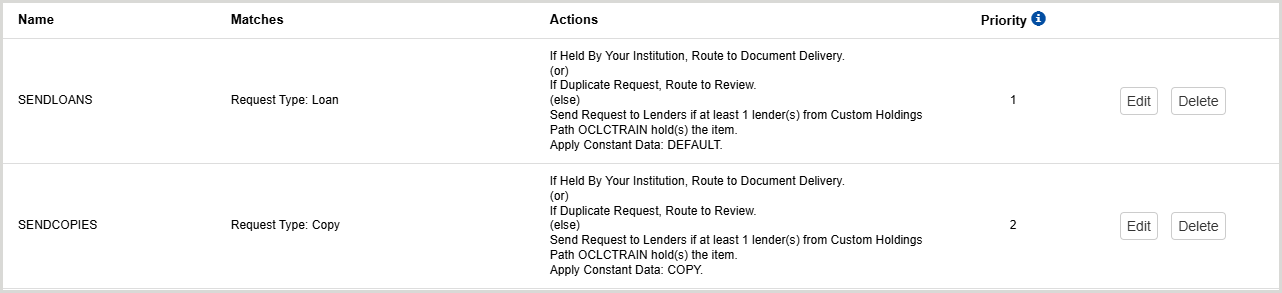
- LOANS:
If the request is not a duplicate and is not held by your institution, the system will apply the Constant Data record and build a lender string based on the holding libraries in the Custom Holdings Path and route the request to Review.
- Under Matches, select Request Type > Loan.
- Click the
 Add an Exception option and select If Duplicate Request, Route to Review.
- Click the Add an Exception option and select If Held By My Institution, Route to Document Delivery.
- Under Actions, select Send Request to Lenders and select the Custom Holdings Path to use.
- An approved patron must be linked to the request in order for the automation to send the request to lenders. If no patron has been linked to the request, or the linked patron is not approved or blocked, the request will be sent to the Review queue.
- Click the Add an Action option and select Apply Constant Data and select the Constant Data record to use.
- COPIES:
If the request is not a duplicate and is not held by your institution, the system will apply the Constant Data record and build a lender string based on the holding libraries in the Custom Holdings Path and route the request to Review.
- Under Matches, select Request Type > Copy.
- Click the Add an Exception option and select If Duplicate Request, Route to Review.
- Click the Add an Exception option and select If Held By My Institution, Route to Document Delivery.
- Under Actions, select Send Request to Lenders and select the Custom Holdings Path to use.
- An approved patron must be linked to the request in order for the automation to send the request to lenders. If no patron has been linked to the request, or the linked patron is not approved or blocked, the request will be sent to the Review queue.
- Click the Add an Action option and select Apply Constant Data and select the Constant Data record to use.
Advanced borrowing automations
The following are examples of how to expand your automations.
Examples
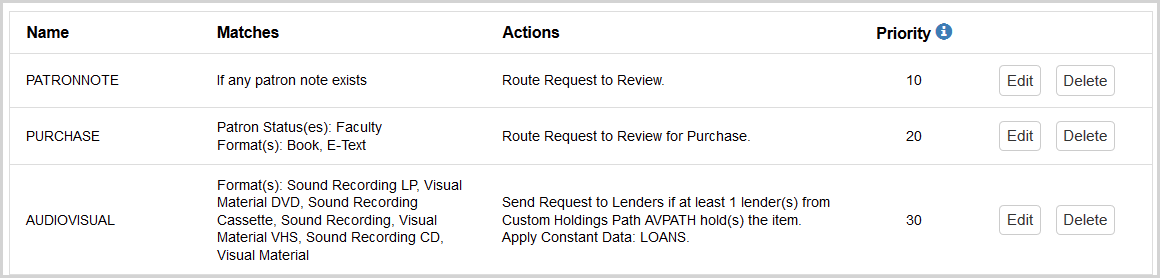
- PATRONNOTE
Any requests that have a patron note will not be sent to lenders, allowing for staff to read the patron's note and fill the request accordingly.
- Under Matches, select Patron Note. Select the Any words checkbox to retrieve requests that have any patron note.
- Under Actions, select Route Request to Review.
- PURCHASE
Books and eBooks requested by faculty will be routed to review for purchase.
- Under Matches, select Patron Status > Faculty.
- Select Add a match and select Formats. Select Book and E-Text from the available list.
- Under Actions, select Route Request to Review for Purchase.
- AUDIOVISUAL
Any request matching the specific formats will be sent to a specific set of lenders configured as a Custom Holdings Group who are known to fill audiovisual requests for a reasonable cost and loan period.
- Under Matches, select Formats and choose Sound Recording LP, Visual Material DVD, Sound Recording Cassette, Sound Recording, Visual Material VHS, Sound Recording CD, and Visual Material. You can select multiple formats from the available list.
- Under Actions, select Build Lender String and select the Custom Holdings Path to use to send to lenders known to fill these types of requests.
- Select Add an Action and select Apply Constant Data and select the Constant Data record to use.
Lending
Using the Automated Request Manager, lenders can choose to apply designated constant data records to lending requests based on the identity of the borrowing library, the type of request, or the material format being requested. This ensures that lending charges, notes, policies, and addresses are accurately applied to lending requests, saving staff time and ensuring compliance with local policies and preferences.
- Automations are applied based on the Automation Priority setting. A patron-generated request is compared against all automations. Of all the automations that match the request, the automation with the highest priority, or lowest assigned Automation Priority number, will be applied to the request.
- Each automation must have a unique numerical value for Automation Priority.
- Assign the highest Priority (lowest number) to your most specific automations.
- If you do not select a match criteria, the automation will apply to all requests.
Standard Actions for Lending
At the top of the screen is a list of the standard actions the system automatically performs on new lending requests. All libraries will see the actions on the left of the screen:
- Deflections
- Supplier status check
- Knowledge base holdings check
- Group affiliations check
- Time to Respond
- Real time availability check
Configure Main Automations for Lending
To add an automation:
- Select the Lending tab.
- Click + Add New.
- The Enable box will be checked by default and the automation will immediately be in effect upon saving. The automation will display Yes in the Enabled column.
- Enter a Name and assign a Priority. See Main Automation fields for Lending fields for more information.
- Select any desired match criteria from the Matches drop-down menu. See Automation Match criteria for Lending for more information.
- Click the Add a match button to configure additional match criteria.
- Click the
- Select any desired actions from the Actions drop-down menu. See Automation Actions for Lending for more information.
- Automations that specify actions but no Match criteria will match all requests.
- Click the Add an Action button to configure additional match criteria.
- Click Save.
To edit an automation:
- From the Main Automations list, select the Edit button associated with the desired automation.
- Edit information, as appropriate. Remove matches, actions, and exceptions with the remove button .
- Click Save.
To delete an automation:
- From the Main Automations list, select the Delete button next to the desired automation.
- On the confirmation window, click Delete.
Main Automation fields for Lending
| Field | Description |
|---|---|
| Enable |
By default, when an automation is created, the Enable box will be checked and the automation will immediately be in effect upon saving. The automation will display Yes in the Enabled column. Staff can edit automations and uncheck the Enable box so the automation is no longer in effect and displays as No in the Enabled column. |
| Name* |
The name of this automation (40-character limit) that indicates the scope of the group of requests to which the automation pertains. The name must be unique.
|
| Priority* |
Set a numeric priority to each automation. The priority must be a positive integer of 9 digits or less.
|
Automation Match criteria for Lending
| Field | Description |
|---|---|
| Borrower Group |
|
| Formats | |
| Request Type |
Specify copy or loan requests:
If no request type is selected, the automation will apply to both copy and loan requests. |
Automation Actions for Lending
| Field | Description |
|---|---|
| Apply Constant Data | Apply a designated Lender Constant Data record as an action. |
Use lending automations with WorldShare ILL
Refer to Automated Request Manager for Lending for use cases and examples.
Use Reports to assess automations
Refer to Assess automations to learn how to access and use the Borrower Resource Sharing and Lender Resource Sharing Stats Reports to track your library's use of automation.