
FirstSearch Basics
About FirstSearch
FirstSearch is an online service that gives library and education professionals access to a rich collection of reference databases. FirstSearch offers electronic access to dozens of databases and more than 10 million full-text and full-image articles. With FirstSearch, materials in your library collection can be identified in search results, facilitating interlibrary loan and helping to connect your users with the information they need.
Log in to FirstSearch using your assigned authorization and password.
Searching
Basic Search
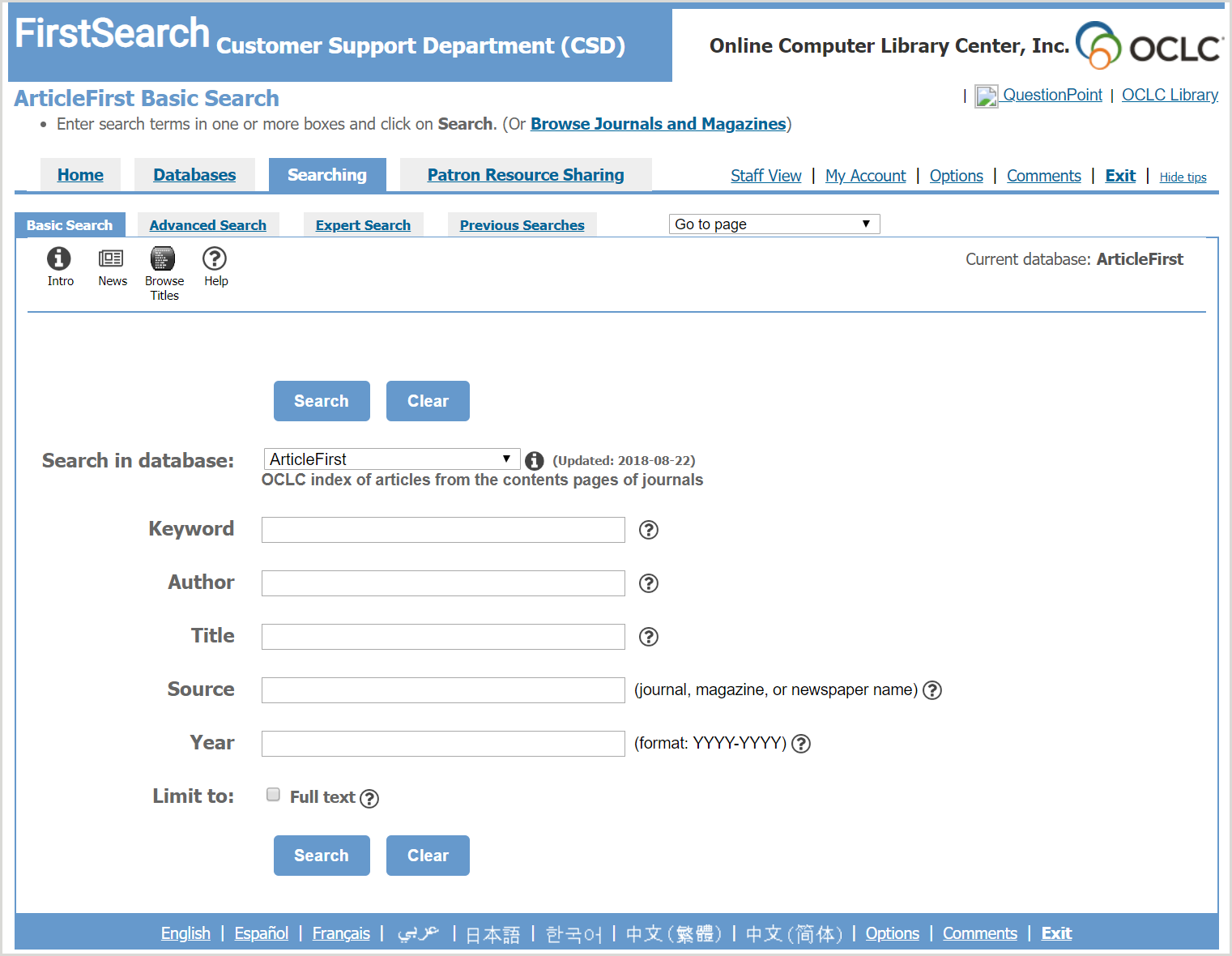
Once you have selected a database to search, the Basic Search screen (see below) allows you to select an index (Keyword, Author, Title) for your search. For a basic search, simply type your search terms in the appropriate box. You can also limit your search results to full-text documents if your authorization includes full-text. Use the Basic Search if you are new to online searching or if you need quick results using a simple search statement.
Advanced Search
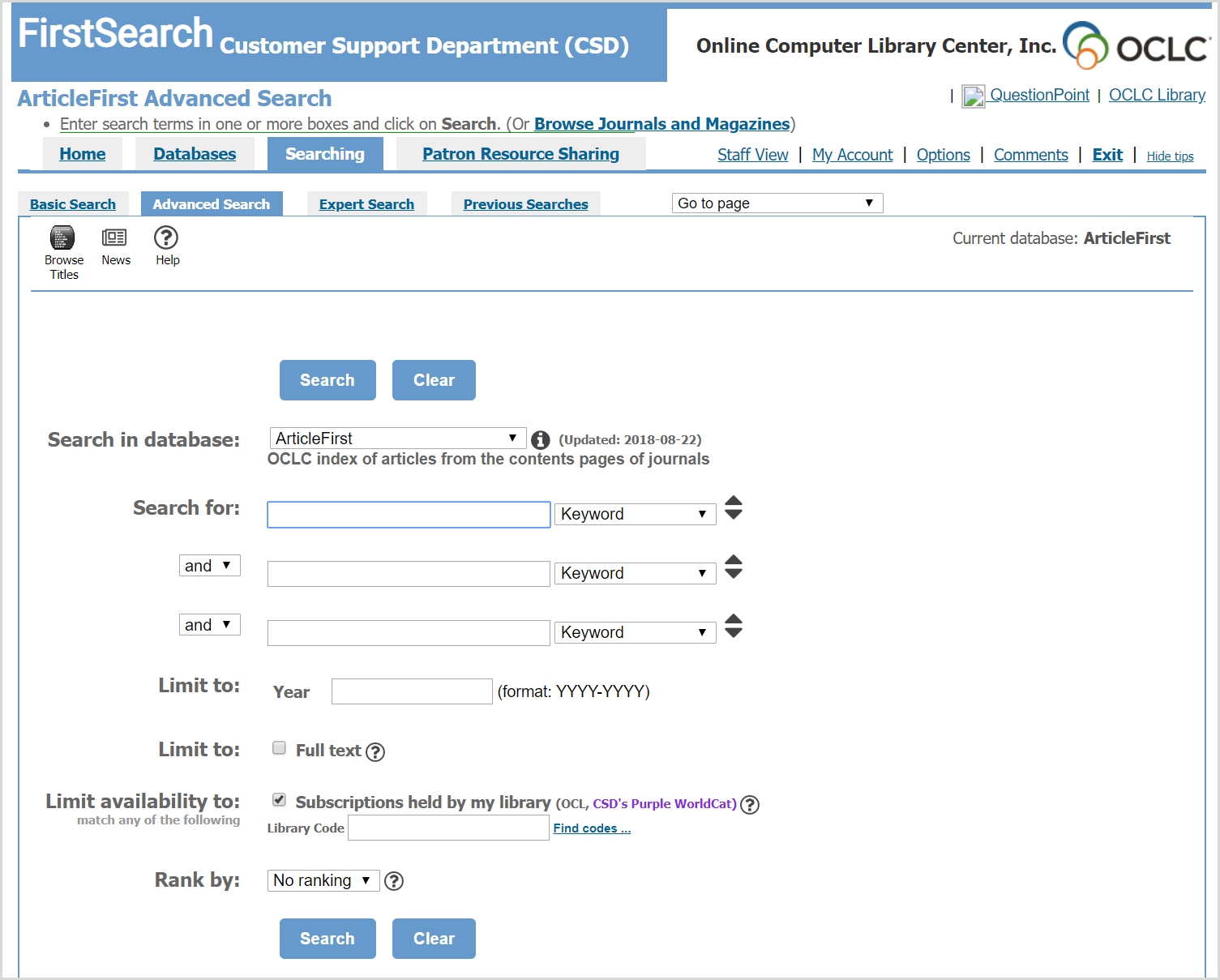
The Advanced Search screen lets you construct more complex searches. Up to three search terms and three indexes can be selected from drop-down lists and combined using Boolean operators (AND, OR, and NOT). Also, more search limits are available at this level.
Expert Search
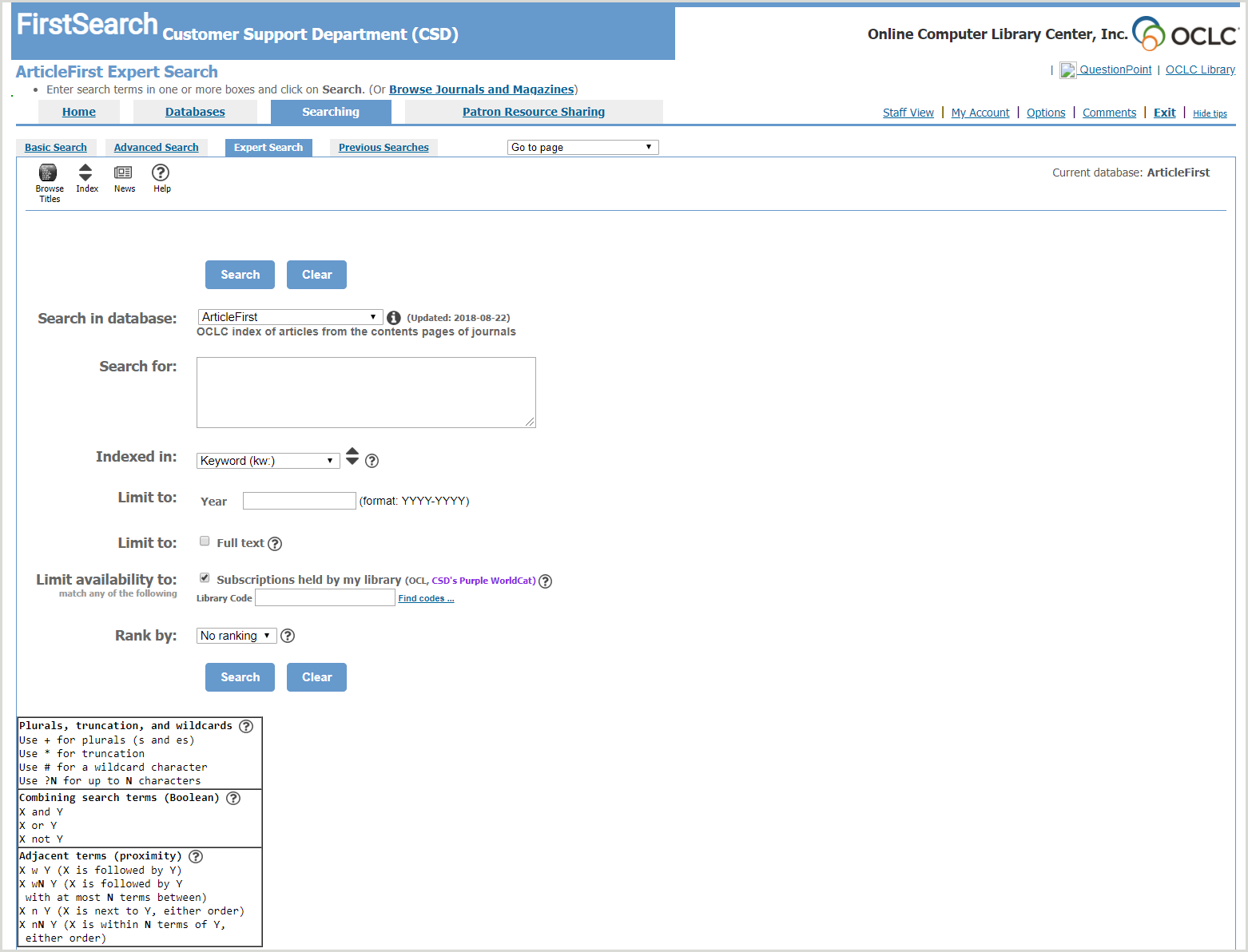
The Expert Search screen is designed for experienced searchers who prefer to enter logical search strings. Reference information on constructing a search is displayed at the bottom of the screen. A list of indexes and index labels is provided in a single drop-down list. The index selected in this menu becomes the default index for any search terms that do not have specific index labels.
Other search features
- Browse the indexes to verify the correct spelling or format for search terms. Click the Index button (
 ) to access the Browse Index feature.
 - Browse subject headings to find additional terms that may apply to your search.
- Click the Subjects button (
 ) to access the Subject Headings list. This feature is only available in certain databases.
 - Use ranking (before you search) to organize the results of your search. Available ranking options vary by database and may include ranking by relevance or date. Ranking by number of libraries holding the item is also available in WorldCat.
Search statements
Search statements are made up of search terms combined with the index(es) being searched. Search statements can also contain special characters, labels, or Boolean operators. In the Basic or Advanced search, the indexes are either pre-selected for you, or can be selected from drop-down lists.
Building search statements
| To search for | Use | Sample search term(s) | Results |
|---|---|---|---|
| subject information | any word or words and the Keyword or Subject index |
frost sangfroid |
many results (common word) few results (rare word) |
| categories of information | index labels | su:sleep ti:moon |
subject "sleep" "moon" in titles |
| defined phrase | quotes " " | "tunnel vision" | tunnel vision |
| singular or plural forms | plus sign + | plant+ | plant, plants, plants', plant's, plantes, plantes' |
| variants or part of a word | wildcard *, #, or ? | zebu* | zebu, Zebulon, zebutte |
| all words | AND | cold AND zinc | cold and zinc |
| one or all words | OR | cold OR zinc | cold, zinc, and cold and zinc |
| one word but not another | NOT | cold NOT weather | "cold" but not "cold weather" |
| words near each other, in given order | w | common w2 cold | common followed within 2 words by cold |
| words near each other, in any order | n | cold n3 common | cold and common within 3 words of each other |
Using index labels with the Expert search
| Use an index label and : | When your search includes | Examples |
|---|---|---|
| colon ( : ) | individual words or fragments of phrases | kw:airline security |
| search operators (w or n) | kw:alcohol w2 fetal | |
| other special search characters such as the plus sign (+) or asterisk (*) | ti:(ocean+ or sea+) and pollut* | |
| equal sign ( = ) | exact phrases as in names and titles | ti=alice in wonderland |
Selecting a database
You can select a database to search on the Basic, Advanced, or Expert Search screens by using the Search in database: drop-down list on the Search screen. FirstSearch also provides three options for selecting a database via the Databases tab. Click the Databases tab and then click a link for one of the following options:
- List All Databases - Displays a merged list of all databases
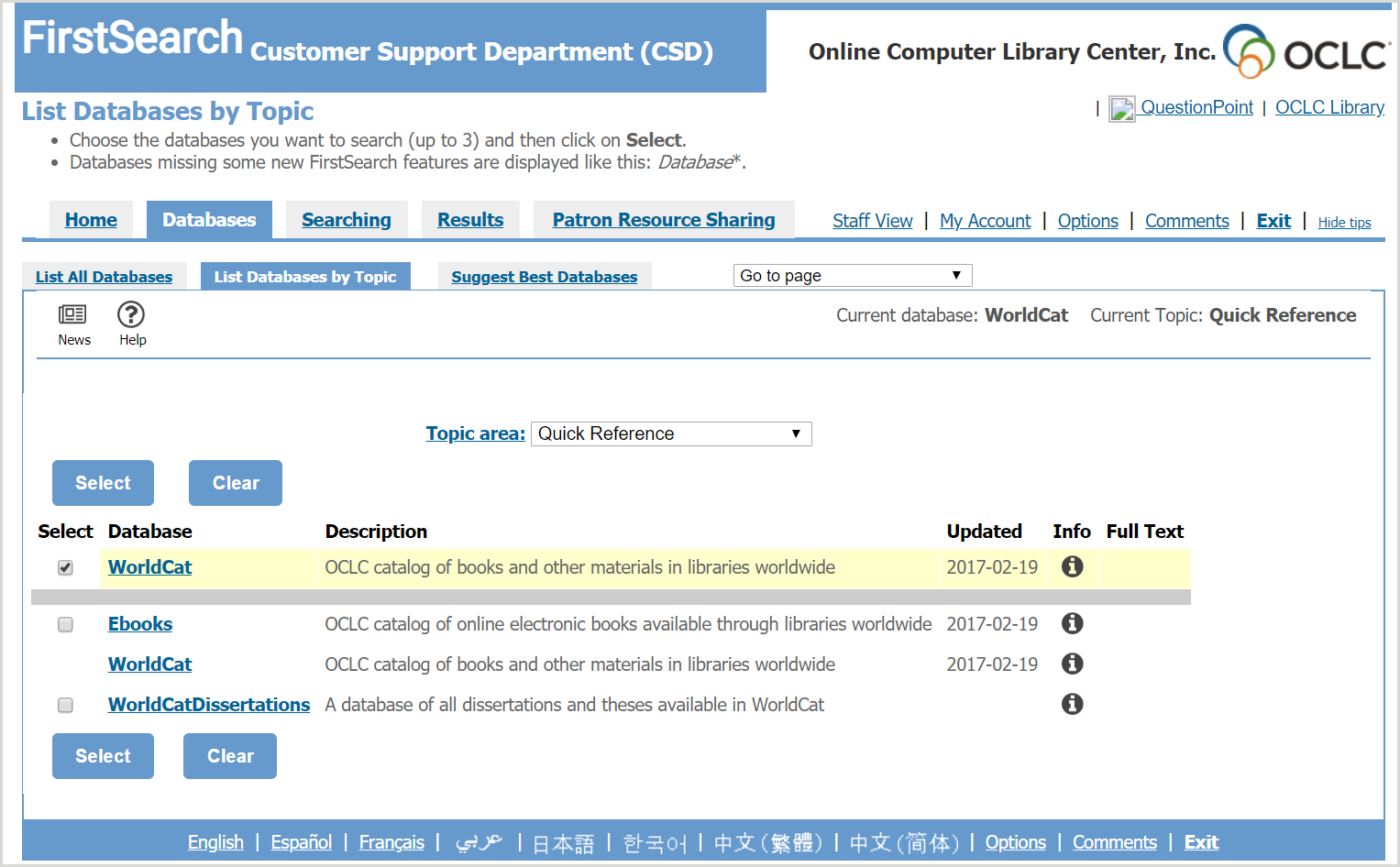
- List Databases by Topic - Groups databases by topic area
If you need help selecting a database, use the Suggest Best Databases option to scan databases for your key search term(s). You can then select the databases that contain the highest estimated results for your key terms.
The Home screen
The Home screen may be the first screen you see in FirstSearch, if your administrator has configured your FirstSearch account that way. You may also reach the Home screen by clicking the Home tab on any FirstSearch screen.
The FirstSearch Home screen provides a simplified, Google-like Search box that enables you to enter search terms and also select a database in which to search. Searches entered from the Home screen use the Keyword search.
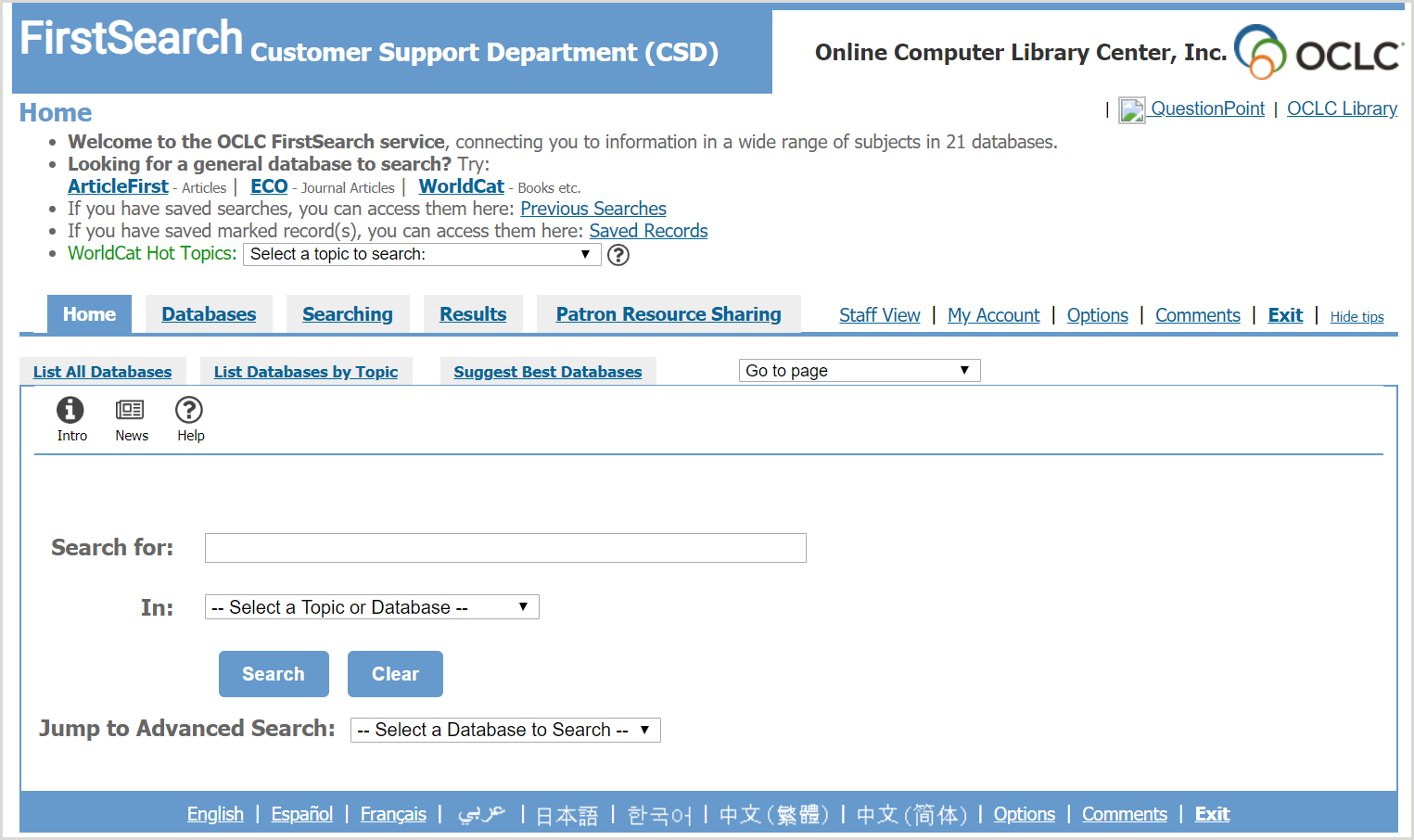
The following functionality is available via the Home screen:
Staff view
Click Staff view to access the FirstSearch staff ILL interface. You will need to sign in with your library's ILL authorization and password to access the interface. From this interface, staff can:
- Search for materials using the discovery view in FirstSearch.
- Display holdings and enter lender strings.
- Enter shipping and billing information and borrowing notes.
- Send requests for materials to OCLC ILL.
This interface also allows access to the following:
- ILL Direct Request in FirstSearch (direct to profile or direct to review)
- Additional tools ILL staff need to allow them to submit requests to the OCLC ILL service (direct to lender)
- All of the functionality of FirstSearch associated with the FirstSearch authorization (Infotrieve, Select Translation Service, pay-per-use article purchasing, etc.)
My Account
My account allows users to create a personal FirstSearch account that can be accessed from any location. Once a personal account has been created, users can save current searches for future use as well as configure personal preference options across multiple sessions.
To register, users must provide the following information. WebJunction users can use their existing WebJunction username and password in FirstSearch.
- User Name
- Password
- First Name
- Last Name
- Geographic location
Note: User names and passwords must be at least 8 characters/numbers.
Options
Click Options to configure preferences for the current session.
The following options can be configured:
| Option | Description |
|---|---|
| Record list size | Select a size from the drop-down list. Sets the total number of brief records that will display on a single page. |
| E-mail address | Enter a default e-mail address for the E-mail Records screen.
Note: FirstSearch defaults to the e-mail address in the personal account profile if a user is already signed in with a personal account. If the user is already signed in with their personal account, this option will not display. |
| JavaScript | Select On or Off. Enables special interactive functions in your browser, such as pop-up windows and automatic information saving. This option is only effective for some browsers and only if JavaScript is enabled in the browser. |
| Screen size | Select from Small, Medium, or Large to customize the display for different screen resolutions. |
| Framed links | Select On or Off. Controls whether full-text image files and external links are displayed in a frame. A framed interface makes it easier to return to FirstSearch |
| Character set |
Select Standard or Unicode.
|
| Colors | Select a color scheme. |
| Highlight search terms |
Controls the highlight used for search terms. The following options are available:
|
Comments
Allows users to submit questions or comments. The WorldCat Admin module can be used to configure a library email address that patron comments can be delivered to, or the form can be used by library staff to contact OCLC Support . For more information, see Send patron comments to your library.
Exit
Click Exit to end the current FirstSearch session and sign out.
Search results
After you perform a search, FirstSearch displays the List of Records screen. To view a detailed record from this screen, click the item's title.
Viewing full text. The Full Text button ( ) and full text format information appear with any record for which full text is available online. Click the button or the format information to see the full text.
Sorting records. Click the Sort button ( ) to select sort options for a result set of 500 or fewer records. Sort options vary by database.
Related records. To find related records, click the Related Authors button ( ) or the Related Subjects button (
 ).
).
Limiting results. To narrow your set of results, click the Limit button ( ) and select from the list of database-specific limits.
Marking a subset of records
You can mark a subset of records in the Search Results list, and then print, email, or export the records. Click the checkbox for each record you want in your subset. Then click the Marked Records link to view, email, or save.
Library ownership information - The My Library Owns icon ( ) are displayed with any resource that your library or library group owns.
WorldCat Services Admin module
The purpose of the WorldCat Services Administrative module is to help you:
- Customize FirstSearch to meet the needs of your users and staff
- Integrate FirstSearch with your library services (such as interlibrary loan)
- Control database searching costs for your library
Basic settings you should be aware of
Logging on to the Administrative module
Access the WorldCat Services Administrative module and log in using your assigned authorization and password. For your initial login, you can use the same authorization and password you use for the FirstSearch user interface.
Passwords
OCLC suggests the following guidelines for new passwords:
- Use at least four, but not more than 10, characters in the password. (You cannot type more than 10 characters when setting a new password in the administrative module.)
- Use only letters (a-z) and/or numbers (0-9) in the password.
- Do not use spaces, punctuation, or symbols in the password.
- For added security, specify different characters for each password. For example, do not specify the same password for the administrative module that you specify for the FirstSearch service.
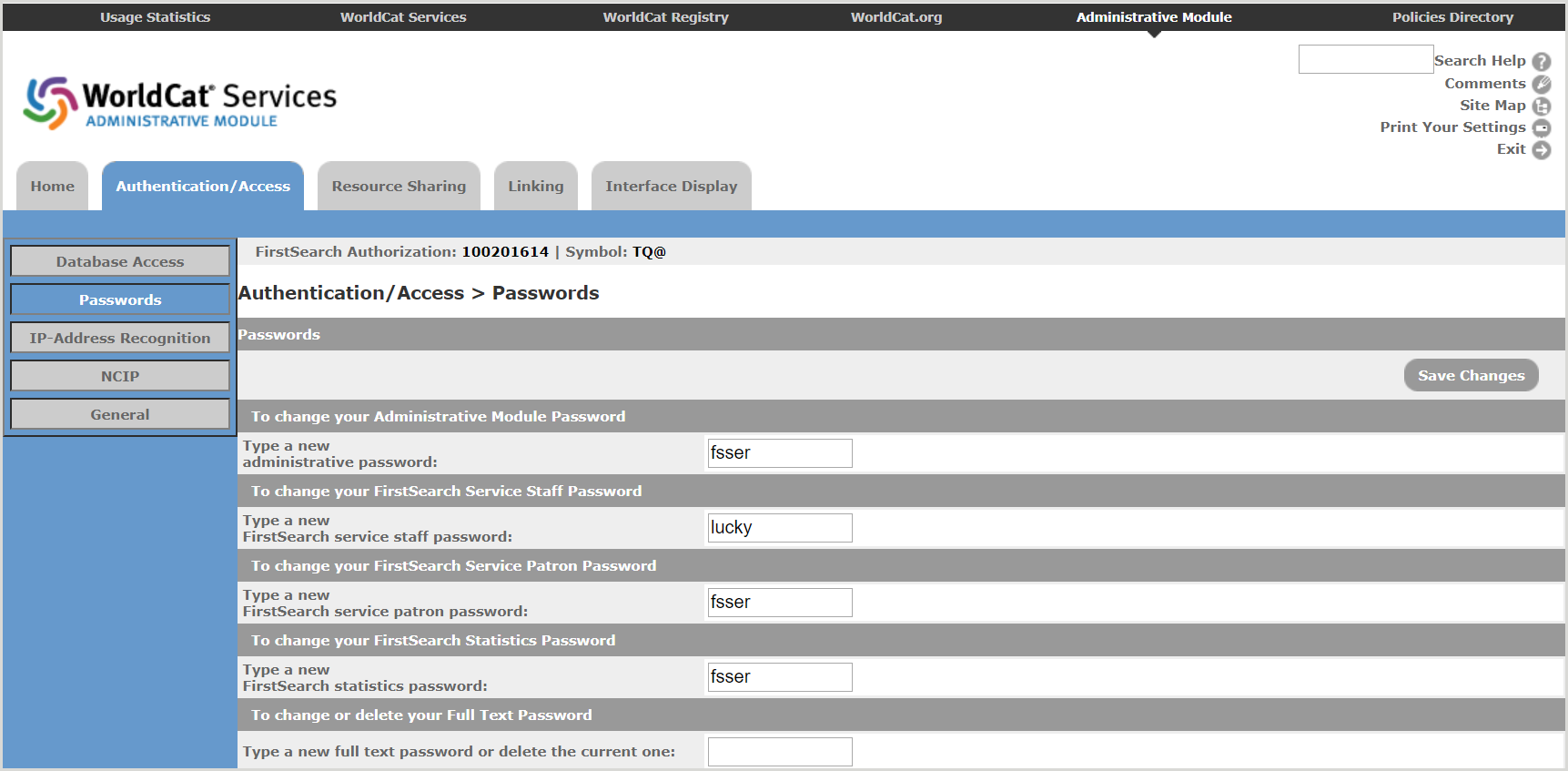
To change your password in the administrative module, click the Authentication/Access tab, then click Passwords in the sidebar menu.
Timeouts
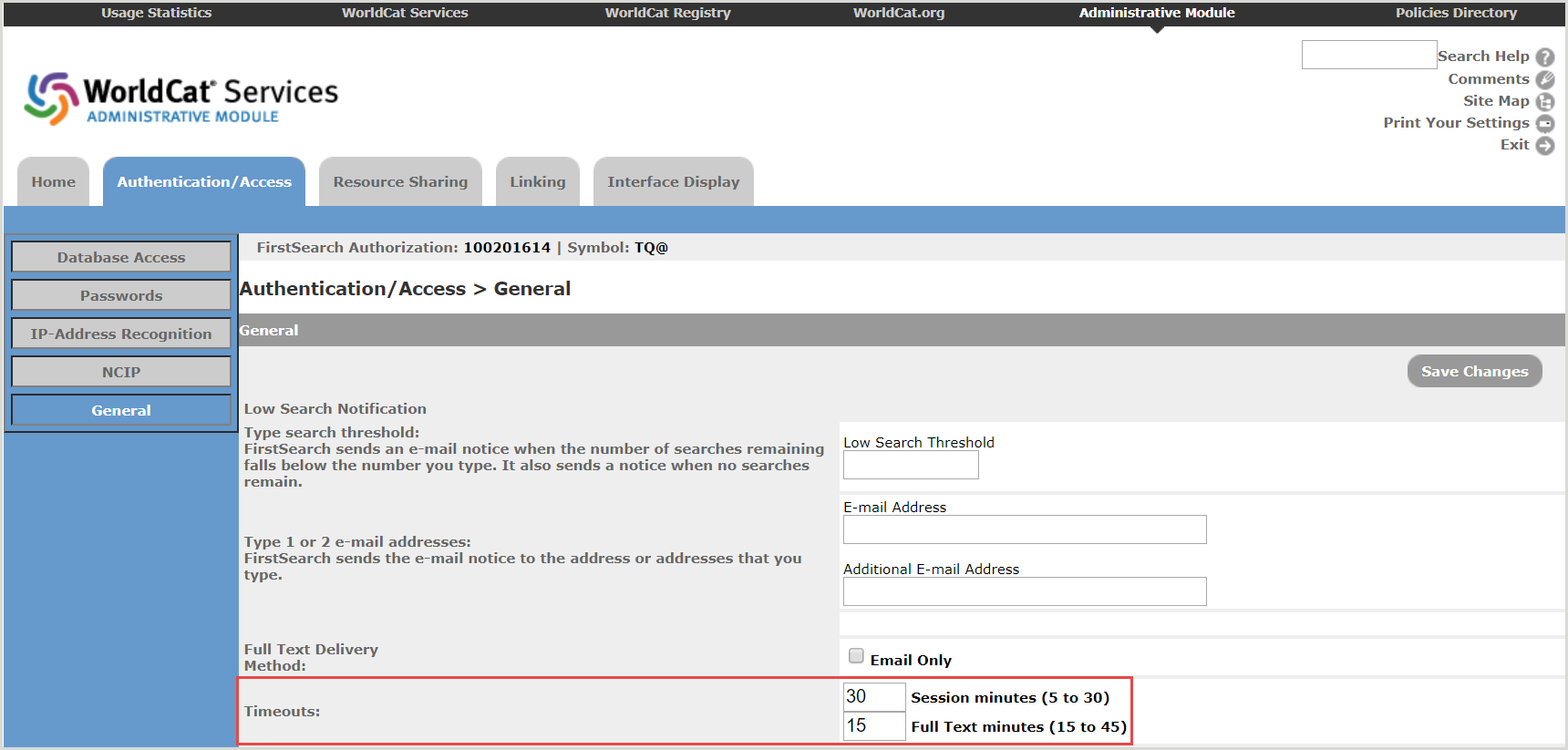
If a user does not send a request to FirstSearch for several minutes, FirstSearch automatically ends the session. In the administrative module, you may specify the number of minutes that FirstSearch waits for a request before ending a session.
To set timeouts, click General in the sidebar menu of the Authentication/Access section.
Session Timeout
Specify the number of minutes (between 5 and 30) that FirstSearch waits for a request before ending the session if the user is viewing any FirstSearch screen (for Full Text Timeouts, see below).
Full Text Timeout
Specify the number of minutes (between 15 and 45) that FirstSearch waits for a request before ending the session if the user is viewing, downloading, or printing the full text of a journal article or other document.
Using IP address recognition
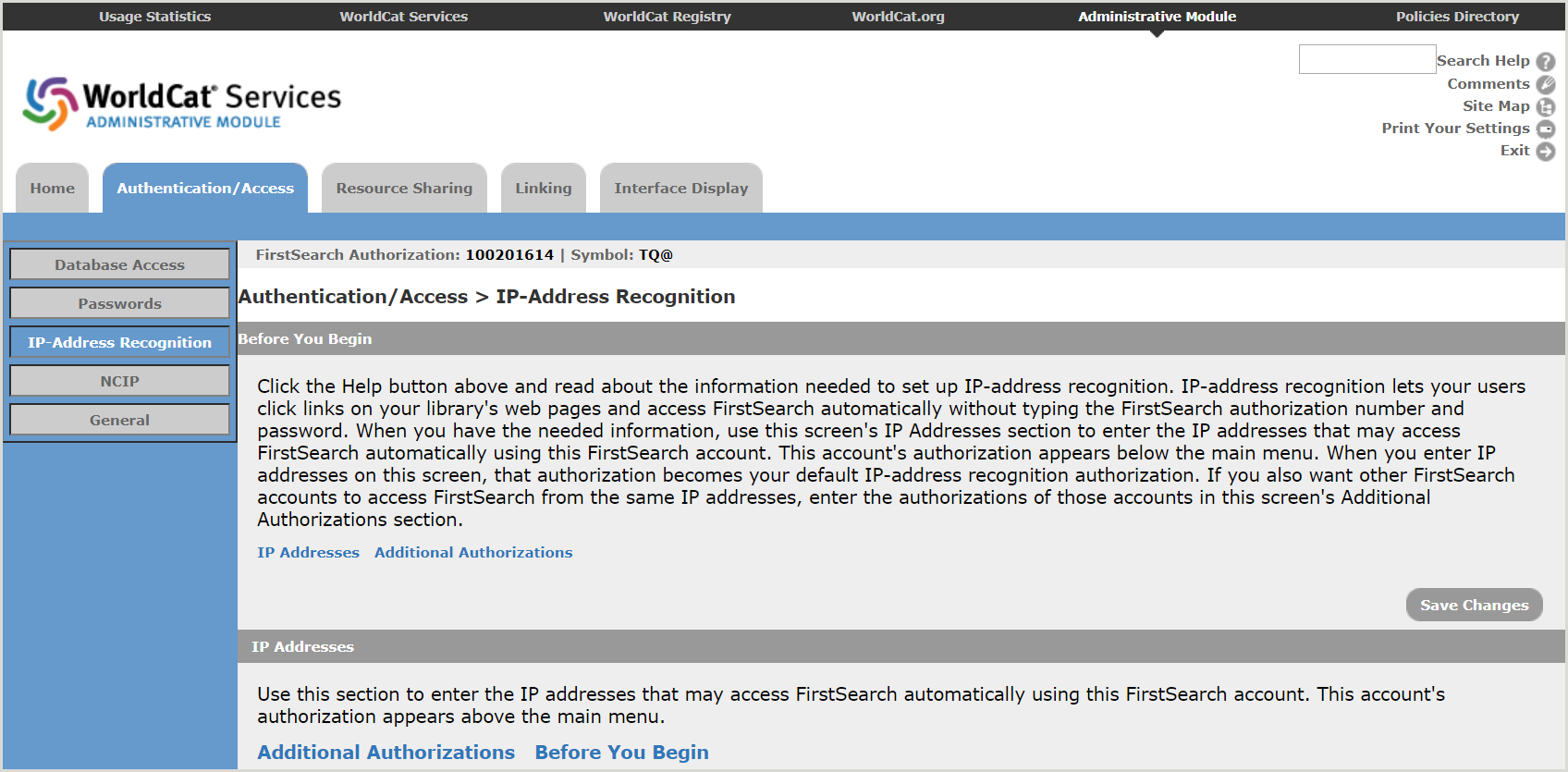
For IP address recognition, you specify which IP addresses may use your FirstSearch authorization to access the system. If you wish, you can add links that lead to FirstSearch from your library's web pages. The links contain special IP address recognition URLs and work only for users with the specified IP address.
Click IP-Address Recognition in the sidebar menu of the Authentication/Access section to define IP addresses that can access FirstSearch.
OpenURL links
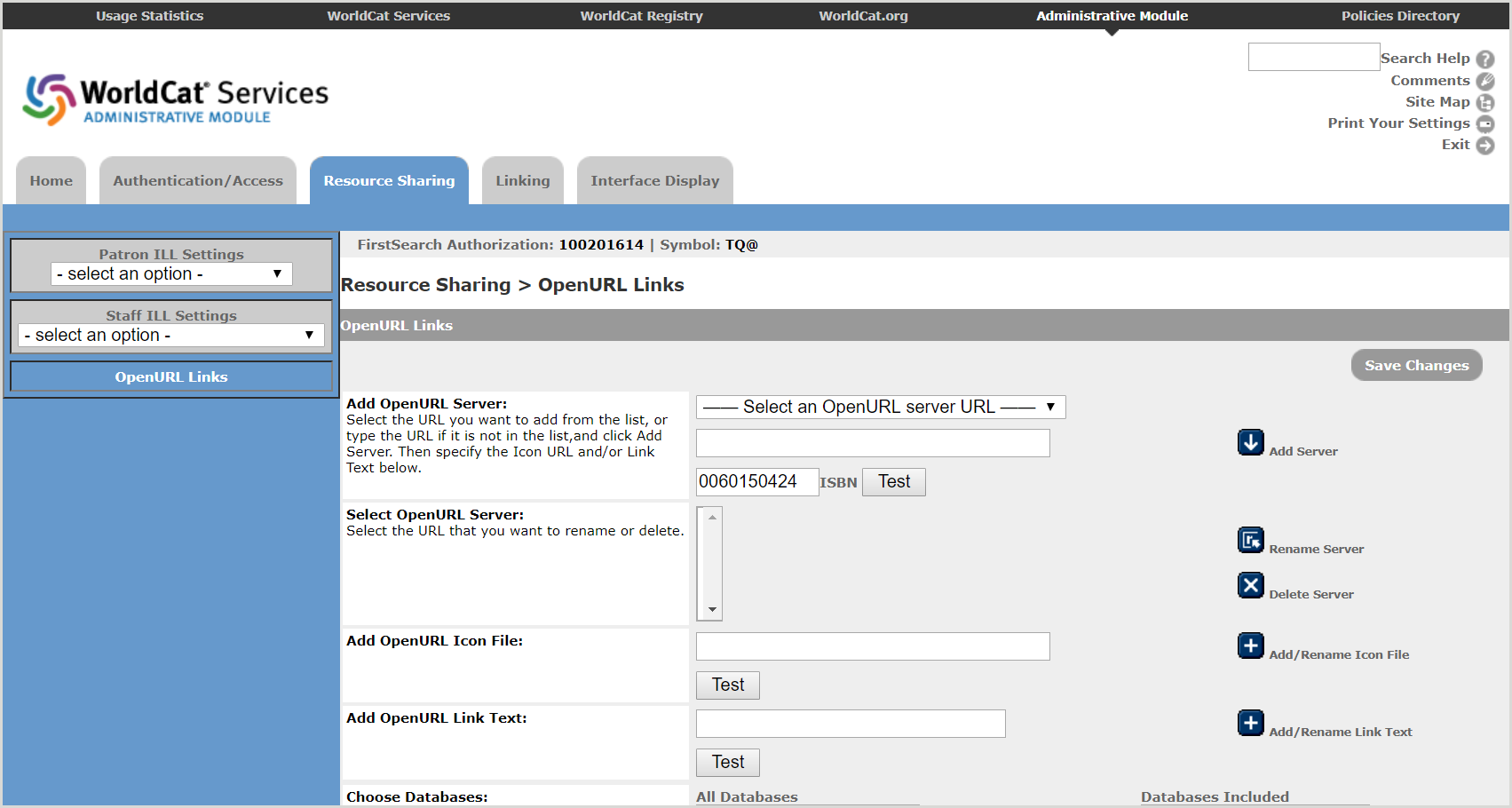
The OpenURL links feature lets you add links in FirstSearch that lead to your library's servers. If you add the links, they appear in detailed records when you search FirstSearch databases. This enables users to more easily find information in your library. You may also use OpenURL links to create links to Ask a Librarian.
To define OpenURL links, click OpenURL links in the sidebar menu of the WorldShare Interlibrary section of the administrative module.
Your Library
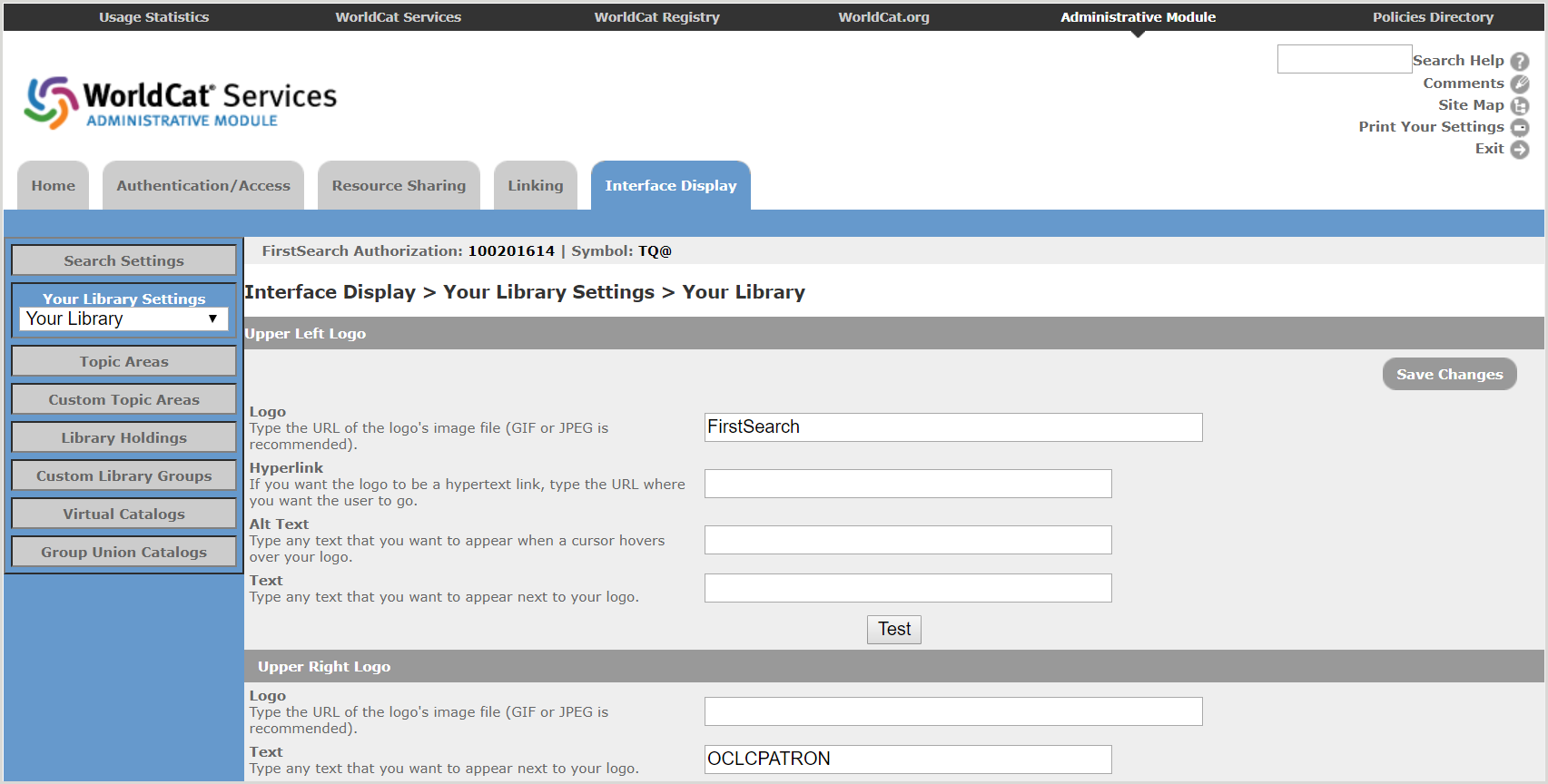
Click Your Library Settings in the sidebar menu of the Interface Display section of the administrative module to customize the interface for your users. See below for Your Library Settings options.
Your library's logo
You can add your library's logo or image to the FirstSearch service by entering the URL of the logo's image file. If you do, your logo appears throughout each FirstSearch session at either the upper left or upper right of each FirstSearch screen, depending on where you designate it to appear.
Your library's custom web links
You can provide links that lead from FirstSearch to web pages that you choose. For example, the links might lead to your library's home page, to your Ask a Librarian page, or to a preferred search engine page.
Note: Any links that you specify appear throughout each FirstSearch session near the top of all FirstSearch screens. If you also add your library's logo to FirstSearch, the links appear directly below the logo.